
How Commercial Solar Lighting Works: Components, Batteries & Performance Explained
Commercial solar lighting is an off-grid lighting solution that uses sunlight to generate electricity during the day, stores that energy in a battery and uses it to power LED lighting after dark.
The basic process is:
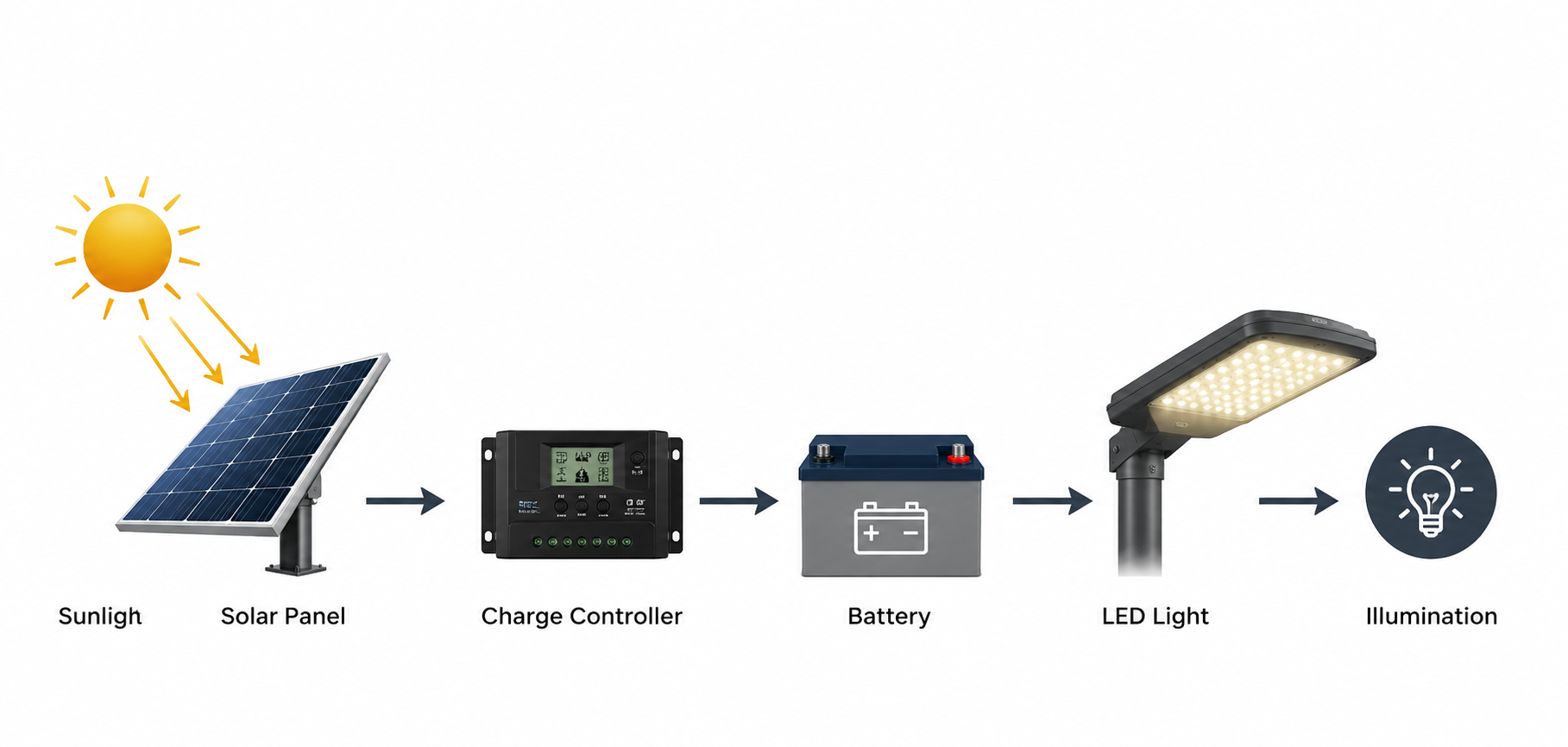
Unlike mains-powered lighting, a standalone solar lighting system does not need to draw electricity from the grid to operate. Instead, its solar panel generates energy during daylight hours, while the battery stores energy for use when the sun is no longer available.
But how does the system actually work, and what determines whether it will provide reliable lighting throughout the night?
This guide explains the main components of commercial solar lighting systems, how batteries work, what happens during cloudy weather and the factors that determine lighting performance and system lifespan.
How Does Commercial Solar Lighting Work?
Commercial solar lighting works by converting sunlight into electrical energy, storing that energy and then using it to operate an LED luminaire when lighting is required.
The operating cycle is straightforward:
Solar panels capture sunlight.
Photovoltaic cells convert sunlight into electrical energy.
The charge controller regulates the energy entering the battery.
The battery stores energy for later use.
The system detects when lighting is required, typically after dark.
The LED luminaire switches on.
The battery supplies power throughout the night.
When daylight returns, the solar panel begins recharging the battery.
Solar panels use photovoltaic cells to convert light energy into electricity. They can still generate some electricity from diffuse sunlight during cloudy conditions, although generation is generally higher when more direct sunlight reaches the panel.
The process can be understood through three stages:
Energy generation
The solar panel generates electricity from available sunlight.
Energy storage
The battery stores some of the generated electricity so it can be used later.
Energy consumption
The LED luminaire uses the stored electricity to produce light when the system is operating.
These three stages need to remain balanced. A solar panel that generates plenty of energy cannot compensate for an undersized battery, while a large battery cannot solve a problem caused by insufficient solar generation.
Commercial solar lighting performance comes from the complete system working together rather than from one component in isolation.
What Are the Main Components of a Commercial Solar Lighting System?
A typical commercial solar lighting system consists of several components that work together to generate, store, control and deliver electrical energy.
| Component | What It Does | Why It Matters |
|---|---|---|
| Solar panel | Generates electricity from sunlight | Determines available energy generation |
| Battery | Stores electrical energy | Determines available energy for overnight operation |
| LED luminaire | Converts electrical energy into light | Determines lighting output and distribution |
| Controller | Regulates energy flow and system operation | Helps manage charging, discharging and lighting |
| Sensors | Detect environmental or operating conditions | Can control when and how much light is produced |
| Pole and mounting hardware | Supports the system and positions components | Affects installation, durability and light distribution |
Each component has a different role, but the system needs to be designed as a complete unit.
Solar Panel
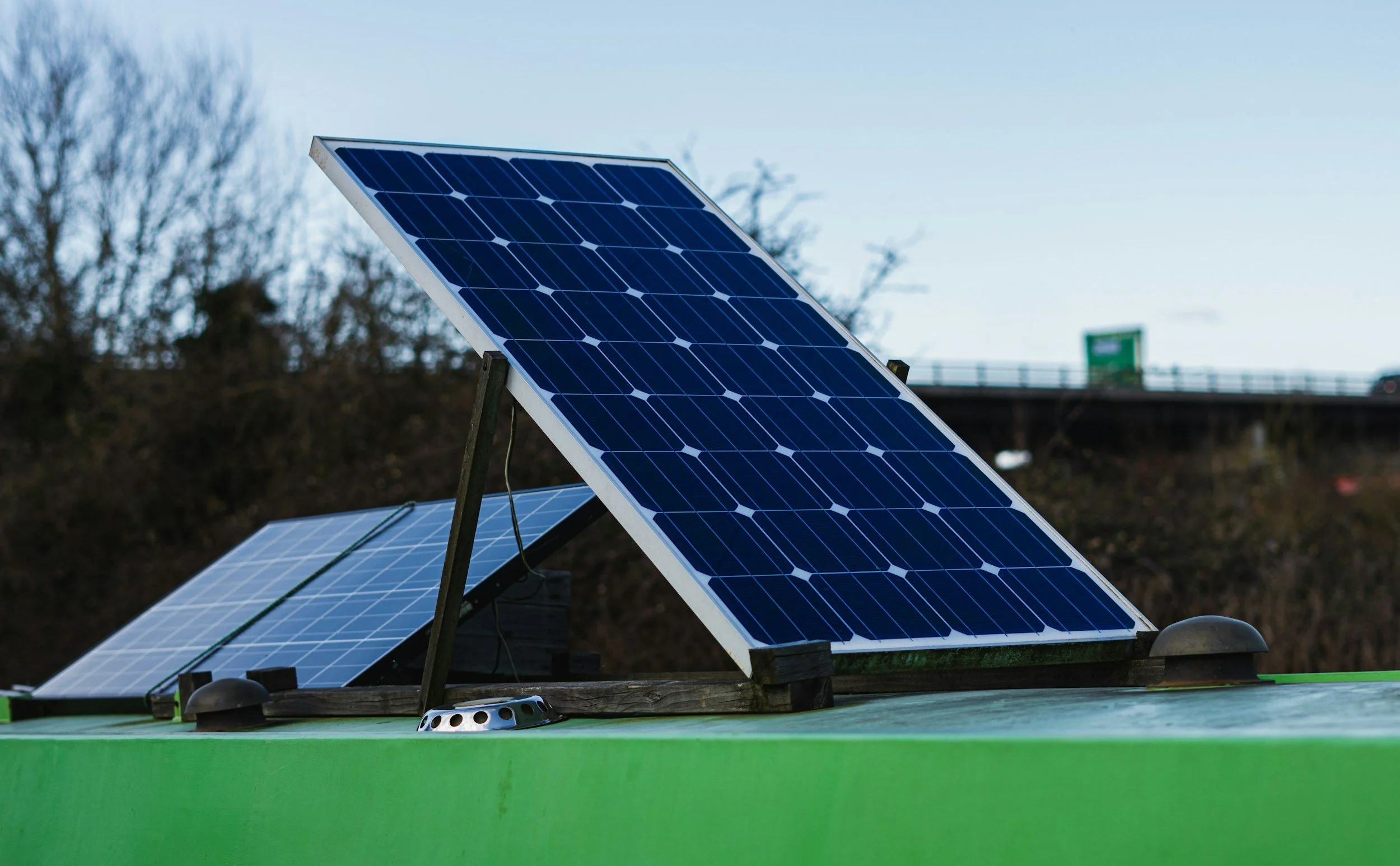
The solar panel is responsible for generating the electrical energy used by the system.
Solar panels contain photovoltaic cells that convert sunlight into electricity. Their rated capacity is normally expressed in watts (W), but the amount of electricity generated in practice depends on available sunlight and operating conditions.
For commercial solar lighting, panel size and positioning are particularly important because the panel needs to generate enough energy to support the lighting requirements and recharge the battery.
Factors affecting solar generation include:
available sunlight
seasonal conditions
shading
panel orientation
panel positioning
site location
weather conditions
It is also important to distinguish between peak panel capacity and actual daily solar generation. A panel's rated wattage does not mean that it will continuously produce that amount of power throughout the day.
LED Luminaire
The LED luminaire is the component that produces the light.
LEDs are well suited to commercial solar lighting because they can produce useful illumination while consuming relatively little electrical energy.
However, higher wattage does not automatically mean better lighting.
Lighting performance also depends on:
lumen output
beam distribution
mounting height
spacing
colour temperature
lighting uniformity
the area that needs to be illuminated
the amount of energy available from the solar and battery system
Lumens describe the amount of visible light produced, while watts describe electrical power consumption. This means comparing lighting products based solely on wattage can be misleading.
The way light is distributed is equally important. A luminaire with a high light output but unsuitable beam distribution may provide poorer illumination across the target area than a lower-powered fitting designed for the application.
Solar Charge Controller
The solar charge controller manages the flow of electrical energy between the solar panel, battery and lighting system.
Its functions can include:
regulating battery charging
controlling energy flow
helping protect the battery
managing discharge
controlling lighting operation
integrating with sensors or programmed lighting profiles
The exact configuration varies between systems. In some commercial solar lighting products, control electronics may be integrated into other components rather than installed as a separate visible unit.
The controller helps coordinate components with different electrical requirements and ensures available energy is managed appropriately.
Sensors and Lighting Controls
Commercial solar lighting does not necessarily have to operate at maximum output for the entire night.
Depending on the system and application, lighting controls may include:
dusk-to-dawn operation
motion detection
programmable dimming
timed operation
For example, a system could operate at a reduced lighting level when an area is unoccupied and increase its output when movement is detected.
These controls can reduce energy consumption by matching lighting output more closely with actual requirements.
Pole and Mounting Hardware
The pole and mounting hardware do more than simply hold the equipment in place.
The installation arrangement can affect:
pole height
solar panel positioning
luminaire mounting angle
light distribution
spacing between lights
exposure to wind
structural requirements
accessibility for maintenance
The physical layout of a solar lighting system therefore needs to be considered alongside the electrical design.
A luminaire mounted at an unsuitable height or angle may not distribute light effectively, even if the luminaire itself has an appropriate light output.
How Do Batteries Work in Commercial Solar Lighting?
The battery is one of the most important components in an off-grid solar lighting system because it allows energy generated during daylight to be used after dark.
During the day, the solar panel generates electricity. Some of that energy is directed towards charging the battery. Once the sun goes down, the battery supplies stored energy to the lighting system.
In simple terms:
Daytime:
Solar panel → Battery charging
Night-time:
Battery → Controller → LED luminaire
Battery capacity is commonly expressed in kilowatt-hours (kWh), representing the amount of electrical energy that can be stored.
However, rated capacity is not necessarily the same as the amount of energy that can be practically used. Batteries have usable capacity and energy losses associated with charging and discharging, and system design generally avoids completely discharging the battery.
For solar lighting, the battery needs to be considered in relation to:
required lighting hours
LED power consumption
lighting controls
expected solar generation
required autonomy
operating conditions
battery chemistry
depth of discharge
expected charging and discharging cycles
This is why simply choosing the largest available battery is not necessarily the right approach.
The battery needs to be appropriately sized for the complete system.
What Type of Batteries Are Used in Solar Lighting?
Several battery technologies can be used for energy storage. Lithium-ion technologies are widely used in modern energy storage applications, including solar systems.
Common technologies include:
lithium-ion
lithium iron phosphate (LiFePO4)
other battery chemistries depending on the system and application
Lithium iron phosphate is a type of lithium-ion battery chemistry. It can be considered for applications where characteristics such as cycle life, thermal behaviour and safety are important.
However, there is no single battery chemistry that is automatically the best choice for every commercial solar lighting project.
Selection should consider:
| Factor | Why It Matters |
|---|---|
| Lifespan | Determines how long the battery may remain suitable for service |
| Usable capacity | Determines how much stored energy can actually be used |
| Charge/discharge behaviour | Affects how the battery responds to daily operation |
| Temperature | Environmental conditions can affect battery performance and life |
| Maintenance | Different technologies have different maintenance requirements |
| Safety | Battery chemistry and installation conditions need to be considered |
| Application | The battery needs to suit the project's operating requirements |
Battery life can be assessed in several ways, including years, charge/discharge cycles and energy throughput. For a commercial project, these factors should be considered alongside warranty conditions, operating conditions and product quality.
How Long Does a Solar Lighting Battery Last?
There is no single lifespan that applies to every solar lighting battery.
Battery lifespan depends on factors including:
battery chemistry
depth of discharge
number of charge/discharge cycles
operating temperature
system design
maintenance
product quality
A battery that is regularly subjected to deep discharge and difficult environmental conditions may perform differently from one operating under more favourable conditions.
This is why battery life should be assessed against the actual project requirements rather than relying on a generic number of years.
What Happens When There Is Not Enough Sunlight?
Commercial solar lighting can continue operating during periods of reduced sunlight, but prolonged poor solar conditions can reduce the amount of energy available.
Solar panels can generate electricity from diffuse sunlight, meaning they can still produce some energy during cloudy weather. However, generation is normally lower than under clear conditions.
This creates an important distinction:
Cloudy weather does not necessarily mean the lights stop working immediately.
The battery provides stored energy that can continue powering the lighting system after solar generation has reduced.
The system's ability to continue operating depends partly on its autonomy.
What Is Solar Lighting Autonomy?
Autonomy refers to how long a solar lighting system can continue operating using stored battery energy when there is insufficient solar generation to fully recharge the battery.
For example, if a system is designed with several nights of autonomy, it can continue operating from stored energy during a period of reduced sunlight.
However, autonomy is not unlimited.
Several consecutive days of poor sunlight can gradually reduce the available battery reserve. The longer the period of low solar generation, the more important appropriate system sizing and energy management become.
Lighting controls can also help. Dimming or motion-activated operation may reduce the amount of energy consumed during periods when full illumination is not required.
For commercial projects, the design needs to consider local solar conditions, expected lighting requirements and the desired level of energy reserve rather than assuming the system will perform identically in every season.
What Determines the Performance of Commercial Solar Lighting?
The performance of a commercial solar lighting system depends on several interconnected factors.
Solar Availability
The amount of sunlight available affects how much energy the solar panel can generate.
Latitude, seasonal conditions, shading and panel positioning can all influence solar generation.
Battery Capacity
The battery determines how much usable energy can be stored for nighttime operation.
A system that requires long operating hours or multiple nights of autonomy may require greater energy storage than one with lower lighting demands.
LED Efficiency
The LED luminaire needs to convert available electrical energy into useful illumination efficiently.
However, efficiency should not be assessed only by wattage or lumen output. The way light is distributed across the target area also matters.
Lighting Requirements
The system needs to provide an appropriate level of illumination for its intended application.
Requirements may differ significantly between:
car parks
commercial developments
public spaces
security lighting
Pole Height and Spacing
Pole height and spacing affect how light reaches the ground.
The luminaire's photometric characteristics, mounting height and spacing need to be considered together to determine whether the required area can be illuminated effectively.
Lighting Controls
Dimming, timers and motion detection can change how much energy the system consumes.
Reducing output when full illumination is not required can help preserve stored energy.
System Design
Perhaps most importantly, all these factors need to work together.
Solar lighting performance is a system-level issue.
A high-quality solar panel cannot compensate for an incorrectly sized battery. A large battery cannot compensate for insufficient solar generation. Likewise, a powerful LED does not necessarily produce better lighting if its beam distribution and installation arrangement are unsuitable.
How Long Do Commercial Solar Lighting Systems Last?
A commercial solar lighting system does not have one universal lifespan because its individual components age at different rates.
| Component | Factors Affecting Lifespan |
|---|---|
| Solar panel | Weather exposure, product quality and environmental conditions |
| LED luminaire | Operating temperature, product quality and usage |
| Battery | Charge/discharge cycles, temperature and depth of discharge |
| Controller | Electrical conditions and environmental exposure |
| Pole | Corrosion, wind and environmental conditions |
The battery is often one of the components that requires particular attention because its useful life is affected by operating conditions and charge/discharge cycles.
Other components may remain operational for longer, meaning replacement does not necessarily involve replacing the complete lighting system.
Environmental exposure is also important. Commercial lighting installations can be exposed to rain, heat, wind, dust, salt air and other site-specific conditions. The appropriate equipment and installation method therefore depend on the location.
Rather than relying on a single lifespan figure, project owners should consider the expected service life and replacement requirements of each major component.
Are Commercial Solar Lights Reliable?
Commercial solar lighting can be a reliable lighting solution when the system is correctly designed, sized and installed for its location and intended use.
However, solar lighting is not automatically reliable in every application.
Reliability depends on:
correct system design
appropriate sizing
quality components
local environmental conditions
battery capacity
available solar energy
installation quality
lighting requirements
ongoing maintenance
The key consideration is whether the system has been designed around the actual site rather than using a generic configuration.
Off-grid solar lighting can be particularly useful where extending mains infrastructure would be difficult, disruptive or expensive. Remote locations, new developments and areas where trenching or underground cabling presents challenges may be suitable candidates.
The important question is therefore not simply whether solar lighting is reliable, but whether the proposed system is appropriately designed for the project conditions.
Solar Lighting vs Mains-Powered Lighting: How Do They Differ?
Solar and mains-powered lighting use different approaches to supplying electrical energy.
| Factor | Solar Lighting | Mains-Powered Lighting |
|---|---|---|
| Electricity supply | Solar-generated | Grid |
| Underground cabling | Usually not required | Often required |
| Trenching | Can often be avoided | May be required |
| Electricity bills | No grid electricity required for operation | Ongoing electricity costs |
| Installation | Site-dependent | Site-dependent |
| Maintenance | Component-based | Component-based |
| Suitable locations | Off-grid and remote sites | Areas with suitable grid access |
Neither technology is universally better.
Mains-powered lighting may be appropriate where reliable grid infrastructure already exists and extending a dedicated solar system does not provide a practical advantage.
Solar lighting can be attractive where off-grid operation, reduced cabling requirements or difficult site access are important considerations.
The right choice depends on the project, site conditions, lighting requirements and whole-of-life considerations.
What Makes a Commercial Solar Lighting System Suitable for a Project?
What Makes a Commercial Solar Lighting System Suitable for a Project?
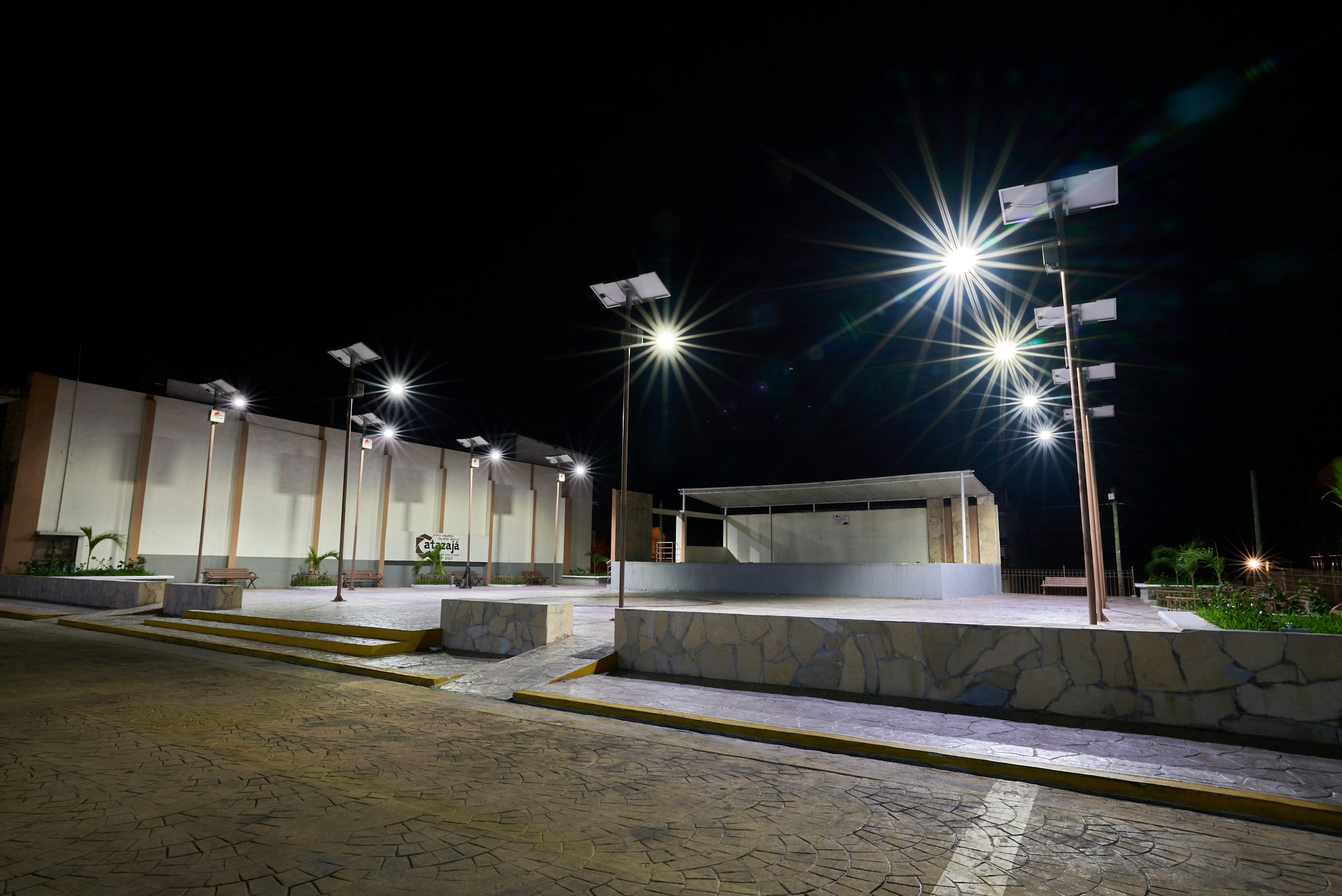
Commercial solar lighting is not suitable simply because a site receives sunlight.
A proper assessment should consider:
site location
solar exposure
shading
lighting requirements
operating hours
required illumination
pole height
pole spacing
environmental conditions
wind region
battery autonomy
budget
installation requirements
The lighting system also needs to be matched to the area being illuminated.
For example, a pedestrian pathway, car park and roadway have different lighting requirements. The luminaire's output and distribution, pole arrangement and operating profile all need to reflect the application.
This is where professional lighting design becomes important.
Photometric modelling and site-specific assessment can help determine whether the proposed luminaires, mounting positions and spacing are capable of producing the required lighting levels.
For a commercial project, this approach is more useful than selecting a solar light based solely on its advertised wattage.
Common Questions About Commercial Solar Lighting
-
Commercial solar lighting uses energy stored in a battery during the day. The solar panel generates electricity from sunlight, which is regulated and used to charge the battery. After dark, a controller or sensor activates the LED luminaire and the battery supplies the stored energy needed to operate the light. The exact operating profile can vary depending on system design, controls and lighting requirements.
-
There is no universal battery lifespan for every commercial solar lighting system. Battery life depends on the chemistry, depth of discharge, number of charge and discharge cycles, operating temperature, system design, maintenance and product quality. When assessing a project, battery life should be considered alongside warranty conditions and expected operating requirements rather than relying on one generic lifespan figure.
-
Yes. Solar panels can generate electricity from diffuse sunlight, so they can continue generating some energy during cloudy conditions. However, energy generation is normally lower than under clear skies. The battery provides an energy reserve that allows the lighting system to continue operating after dark, so the impact of cloudy weather depends on the system's solar generation, battery capacity, lighting demand and autonomy.
-
Several consecutive days of poor sunlight can reduce the energy available for charging the battery. A properly designed system can account for this by providing an appropriate level of battery autonomy and using energy-saving lighting controls where suitable. However, autonomy is not unlimited. Prolonged periods of low solar generation can eventually reduce the available battery reserve, which is why local solar conditions need to be considered during system design.
-
The operating time depends on the system design. Important factors include the amount of stored battery energy, LED power consumption, required lighting output, solar generation and any dimming or motion-sensor settings. A system designed for continuous illumination throughout the night will have different energy requirements from one that dims during low-use periods or increases output only when movement is detected.
-
Solar lighting can replace mains-powered lighting in some applications, particularly where an off-grid solution is practical. However, suitability depends on the site, required illumination, operating hours, solar availability, battery autonomy, pole arrangement and environmental conditions. It should not be assumed that every mains-powered lighting application can be replaced with an identical solar configuration. A site-specific assessment is normally required.
-
Commercial solar lighting systems can require maintenance even though they do not use grid electricity. Requirements depend on the system and location, but may include checking the solar panel, luminaire, battery, controller, mounting hardware and surrounding environment. Dirt, shading, physical damage, corrosion or component degradation can affect performance, so an appropriate inspection and maintenance approach should be established for the project.
-
Brightness depends on the LED luminaire and the complete lighting design rather than simply the system's wattage. Lumens describe the amount of light produced, while factors such as beam distribution, mounting height, spacing and the intended application affect how that light is delivered across an area. This is why lighting output should be assessed in the context of the complete installation rather than wattage alone.
-
Yes. Off-grid operation is one of the potential applications of commercial solar lighting. Because a standalone system can generate and store its own electricity, it may be suitable for locations where grid connection, underground cabling or trenching is difficult. However, remote sites still require careful consideration of solar availability, environmental conditions, accessibility, battery autonomy, lighting requirements and installation logistics.
-
System sizing involves considering the amount of solar energy available at the site, the lighting output required, operating hours, battery capacity, desired autonomy, pole arrangement, environmental conditions and lighting controls. The solar panel and battery need to be matched to the energy demand, while the LED luminaire and mounting arrangement need to provide appropriate illumination across the target area. Professional lighting design can help determine the appropriate configuration.
Conclusion
Commercial solar lighting works by combining several systems into one coordinated lighting solution:
Solar generation + battery storage + LED efficiency + controls + system design + site conditions
The solar panel generates electrical energy during daylight. The battery stores that energy for use after dark, while the controller manages the flow of energy and the LED luminaire converts it into useful illumination.
However, reliable performance depends on more than simply choosing a solar panel, battery or high-output LED.
Solar availability, battery capacity, lighting requirements, pole positioning, controls, environmental conditions and overall system design all influence how a commercial solar lighting system performs.
This is why commercial solar lighting should be assessed around the requirements of the site and the application rather than based on individual component specifications.
Need help determining whether commercial solar lighting is suitable for your site? eSolar Lighting Australia can assess your requirements and help develop an appropriate lighting solution.
