
Commercial Solar Lighting Buying Guide
Commercial solar lighting has become a practical, cost-effective solution for illuminating outdoor spaces without relying on the electrical grid. Advances in LED technology, battery storage and solar efficiency have made today's systems suitable for a wide range of commercial applications, from local council streets and public parks to school campuses, industrial facilities and construction sites.
Choosing the right commercial solar lighting system, however, involves more than selecting the brightest fixture or the lowest price. Factors such as site conditions, lighting requirements, battery autonomy, pole height, compliance with Australian Standards and long-term maintenance all influence whether a system will perform reliably for years to come.
This buying guide explains the key considerations when selecting commercial solar lighting for your project. You'll learn how these systems work, where they're most commonly used, the different types available, and the technical factors that matter when comparing products. Whether you're planning a new development, upgrading existing infrastructure or specifying lighting for a public space, this guide will help you make a more informed purchasing decision.
What Is Commercial Solar Lighting?
Commercial solar lighting refers to professional-grade outdoor lighting systems that generate, store and use solar energy to power high-performance LED luminaires without requiring a connection to the electricity grid. Unlike decorative garden lights commonly found in residential settings, commercial systems are engineered to provide reliable illumination for larger public, commercial and industrial environments where performance, durability and compliance are essential.
Most commercial solar lighting operates as a completely off-grid lighting solution, making it particularly valuable in locations where extending mains power would be expensive, disruptive or impractical.
How Commercial Solar Lighting Works
A commercial solar lighting system typically consists of several integrated components that work together to deliver dependable lighting throughout the night.
During daylight hours:
The solar panel captures sunlight and converts it into electricity.
A smart controller regulates charging to maximise efficiency and protect the battery.
Energy is stored in a high-capacity LiFePO₄ (Lithium Iron Phosphate) battery.
After sunset:
The controller automatically activates the LED luminaire.
Stored energy powers the light according to the programmed operating schedule.
Optional motion sensors can increase brightness when movement is detected, helping conserve battery capacity during quieter periods.
Modern commercial systems are designed to continue operating even after several consecutive cloudy days by incorporating appropriately sized battery storage and intelligent energy management.
Key Components of a Commercial Solar Lighting System
Although designs vary between manufacturers, most commercial solar lighting systems include the following components:
| Component | Purpose |
|---|---|
| Solar Panel | Converts sunlight into electrical energy during the day. |
| LED Luminaire | Produces efficient, high-quality illumination with low energy consumption. |
| LiFePO₄ Battery | Stores energy for overnight operation and extended autonomy during poor weather. |
| Solar Controller | Manages charging, battery protection and lighting schedules. |
| Motion Sensor (Optional) | Adjusts brightness based on movement to improve efficiency and extend battery life. |
| Pole & Mounting Hardware | Supports the lighting system and withstands local environmental conditions. |
Selecting high-quality components is essential, as overall system performance depends on how well these elements work together rather than the specification of any single part.
Common Applications
Commercial solar lighting is used across a diverse range of projects throughout Australia where reliable outdoor illumination is required without the cost or complexity of trenching electrical cables.
Common applications include:
Local council streets and public roads
Shared pedestrian and cycling pathways
Schools, universities and educational campuses
Public parks and recreational areas
Commercial buildings and business parks
Industrial facilities and warehouses
Car parks
Construction and infrastructure projects
Remote facilities
Mining and agricultural sites
Each application has different lighting objectives, which is why selecting the appropriate system for the environment is just as important as choosing the fixture itself.

Benefits of Commercial Solar Lighting
Commercial organisations are increasingly adopting solar lighting because it offers more than environmental benefits. When designed correctly, modern solar lighting systems can reduce installation costs, simplify maintenance and provide dependable illumination in locations where traditional electrical infrastructure would be expensive or difficult to install.
Below are some of the key advantages commercial buyers should consider.
Lower Installation Costs
One of the most significant benefits of commercial solar lighting is the potential to reduce installation costs.
Traditional lighting projects often require:
trenching
underground electrical cabling
switchboards
conduits
electrical connections
ongoing utility coordination
These civil works can represent a substantial portion of the total project budget.
Because commercial solar lights operate independently, installation is generally limited to the pole foundation, pole installation and commissioning, significantly reducing labour and excavation requirements.
For many council, civil and remote infrastructure projects, avoiding extensive trenching can deliver considerable project savings.
No Trenching Required
Excavation is often one of the most disruptive aspects of installing conventional outdoor lighting.
Trenching may involve:
road closures
footpath disruption
landscaping repairs
traffic management
reinstatement works
underground service location
Solar lighting eliminates much of this disruption by operating entirely off-grid.
This makes it particularly attractive for:
existing parks
heritage sites
recreational reserves
school grounds
remote pathways
environmentally sensitive locations
No Electricity Bills
Since commercial solar lighting generates its own power, there are no ongoing electricity costs associated with operating the lighting system.
Over many years, this can contribute to lower operational expenditure, particularly for projects involving multiple light poles across large sites such as:
council parks
car parks
industrial estates
university campuses
walking trails
While batteries and components may eventually require replacement, eliminating ongoing energy costs can improve the overall lifecycle value of the installation.
Sustainability and Reduced Carbon Footprint
Many organisations are working towards sustainability targets and reducing greenhouse gas emissions.
Commercial solar lighting supports these objectives by:
generating renewable energy on-site
reducing reliance on grid electricity
lowering operational emissions
supporting environmentally responsible infrastructure projects
For councils, developers and organisations seeking Green Star or sustainability-focused developments, solar lighting may contribute towards broader environmental initiatives.
Reduced Maintenance Requirements
Modern commercial solar lighting systems are designed with long service lives and minimal routine maintenance.
Quality systems typically feature:
high-efficiency LED luminaires with long operating lifespans
corrosion-resistant materials
sealed electronics
durable LiFePO₄ batteries
intelligent charge controllers
Routine maintenance generally involves periodic inspections, cleaning the solar panel where necessary and checking mounting hardware.
Selecting products with proven component quality and comprehensive warranties can further reduce maintenance requirements over the life of the system.
Ideal for Remote Locations
Not every project has convenient access to mains electricity.
Commercial solar lighting is particularly well suited to remote environments where connecting to the grid would be impractical or prohibitively expensive.
Examples include:
rural roads
remote parks
walking trails
mining operations
temporary construction sites
agricultural facilities
infrastructure projects
In these situations, solar lighting provides dependable illumination without extending electrical infrastructure over long distances.
Greater Energy Independence
Because each light operates independently, commercial solar lighting is less reliant on the external electricity network.
This independence can provide additional resilience in areas where power interruptions may occur, helping maintain outdoor lighting even when grid electricity is unavailable.
For critical pathways, emergency access routes and public infrastructure, this can be an important operational consideration.
Long-Term Value
While the initial purchase price of commercial solar lighting may sometimes be higher than conventional fixtures alone, evaluating the complete project cost often tells a different story.
When considering:
reduced civil works
lower installation costs
zero electricity bills
minimal maintenance
long operating life
many organisations find that commercial solar lighting delivers strong long-term value over the life of the asset.
Rather than focusing solely on upfront cost, commercial buyers should assess the total cost of ownership when comparing lighting options.
For this reason, councils, developers, engineers and procurement teams increasingly evaluate commercial solar lighting as a long-term infrastructure investment rather than simply another lighting product.
Where Commercial Solar Lighting Is Commonly Used
Commercial solar lighting is suitable for a wide variety of outdoor environments where reliable illumination, lower operating costs and simplified installation are priorities. The right lighting solution depends on how the space is used, required light levels, operating hours and local environmental conditions.
The table below outlines some of the most common applications and the key considerations for each.
| Application | Typical Objectives | Common Lighting Types |
|---|---|---|
| Local Councils | Improve public safety, illuminate streets, parks and shared pathways while reducing infrastructure costs. | Solar street lights, pathway lights, area lights |
| Schools & Universities | Increase visibility for students and staff around pathways, entrances, sporting facilities and car parks. | Pathway lights, bollards, car park lighting |
| Commercial Car Parks | Improve pedestrian safety and vehicle visibility without extensive electrical works. | Solar car park lights, area lights |
| Public Parks & Recreation Areas | Provide reliable illumination for walking paths, playgrounds and public amenities. | Pathway lights, bollards, street lights |
| Industrial Facilities | Enhance security and operational safety across loading areas, storage yards and access roads. | Flood lights, area lights, street lights |
| Construction Sites | Deliver temporary or semi-permanent lighting without installing mains power. | Solar flood lights, portable lighting systems |
-
Local governments frequently specify commercial solar lighting for public infrastructure projects where extending mains power would significantly increase project costs.
Typical applications include:
shared pedestrian pathways
reserve entrances
local roads
parks
playgrounds
foreshore developments
recreational facilities
Solar lighting also allows councils to illuminate previously unlit areas without extensive excavation or disruption to surrounding landscapes.
-
Educational institutions require safe, well-lit environments for students, staff and visitors, particularly during early mornings, evenings and winter months.
Commercial solar lighting can be used to illuminate:
campus pathways
pedestrian crossings
outdoor learning areas
sports precincts
bicycle parking
staff and visitor car parks
Because many campuses continue to expand over time, off-grid lighting also offers flexibility when adding new infrastructure without upgrading existing electrical networks.
-
Well-designed car park lighting improves visibility, supports security and enhances user confidence after dark.
Solar car park lighting is commonly used for:
retail centres
office complexes
industrial facilities
sporting venues
community centres
The ability to install lighting without trenching across existing asphalt can significantly reduce project disruption.
-
Public open spaces often present challenges for traditional electrical installation due to distance from available power supplies.
Commercial solar lighting provides an effective solution for:
walking trails
cycling paths
picnic areas
boardwalks
playgrounds
public amenities
Motion sensor functionality can also help conserve stored energy during periods of low activity while maintaining safety when users are present.
-
Industrial sites frequently require reliable lighting across large outdoor areas where electrical infrastructure may be costly to extend.
Applications include:
storage compounds
logistics yards
perimeter roads
equipment storage
maintenance areas
Depending on operational requirements, higher-output solar area lights or flood lights may be selected to provide broader coverage.
-
Construction projects often need temporary lighting that can be installed quickly without permanent electrical infrastructure.
Commercial solar lighting can provide illumination for:
site access roads
temporary compounds
equipment storage
pedestrian routes
work zones
As projects progress, lighting systems can often be relocated more easily than conventional wired installations, providing greater flexibility throughout different construction phases.
Types of Commercial Solar Lighting
Commercial solar lighting is available in several configurations, each designed to suit different environments, lighting objectives and installation requirements. Selecting the right fixture is just as important as choosing the correct system capacity, as different applications require different light distribution patterns, mounting heights and operating profiles.
Solar Street Lights
Solar street lights are designed to illuminate roads, access streets, public spaces and large pedestrian areas. They are typically mounted on taller poles to provide broad, uniform light distribution over larger distances.
Common applications include:
Residential streets
Local roads
Council infrastructure
Industrial access roads
Shared pathways
Public open spaces
Many commercial solar street lights feature programmable lighting profiles and motion sensors to optimise battery usage while maintaining appropriate illumination throughout the night.
Solar Pathway Lights
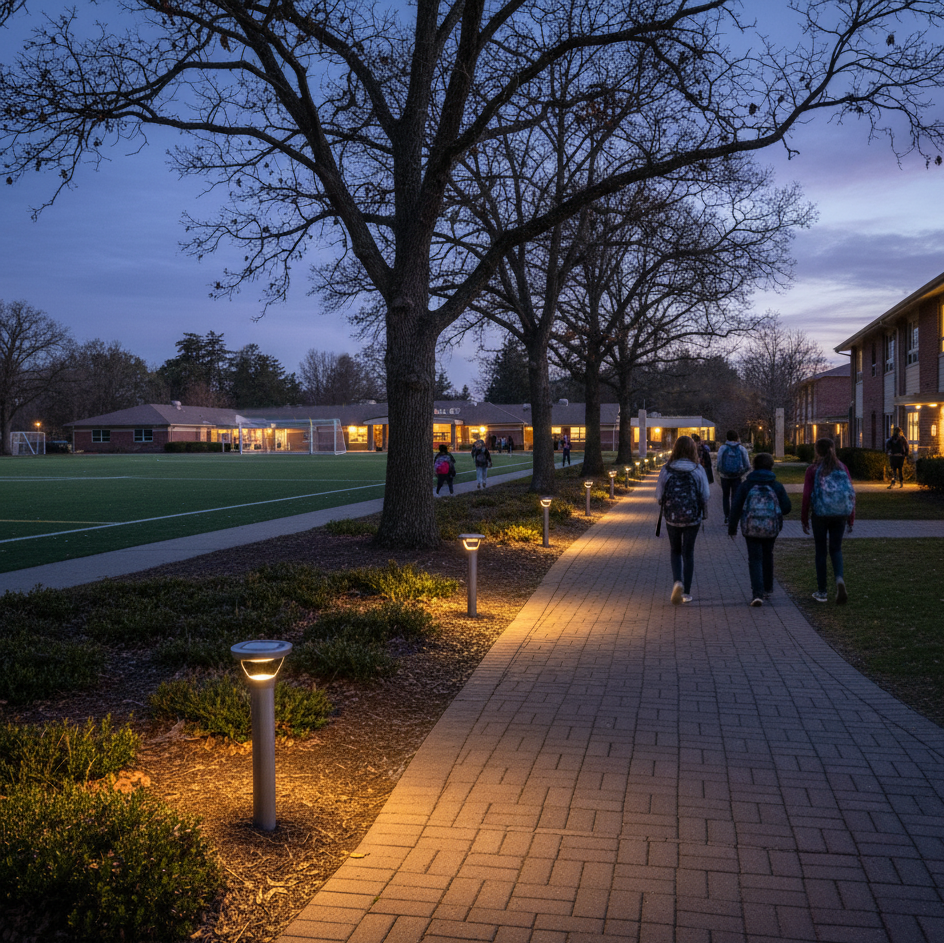
Solar pathway lighting provides consistent illumination for pedestrian routes while improving visibility and safety after dark.
These systems are commonly installed along:
Footpaths
Shared walking and cycling trails
School campuses
University grounds
Parks
Retirement villages
Commercial landscapes
Rather than producing maximum brightness, pathway lighting focuses on creating comfortable, even illumination that assists pedestrians with navigation.
Solar Bollard Lights
Solar bollards are shorter fixtures that provide low-level lighting close to the ground. They are often selected where aesthetics are just as important as functionality.
Typical applications include:
Garden pathways
Public plazas
Outdoor dining areas
Building entrances
Landscape features
Civic spaces
Bollard lighting is generally intended to improve pedestrian guidance rather than illuminate large areas.
Solar Flood Lights
Solar flood lights deliver concentrated, high-output illumination over targeted areas.
They are commonly used for:
Construction sites
Equipment yards
Security lighting
Industrial facilities
Loading zones
Sporting facilities
Many commercial flood lights offer adjustable beam angles, allowing installers to direct light exactly where it is needed.
Solar Car Park Lights
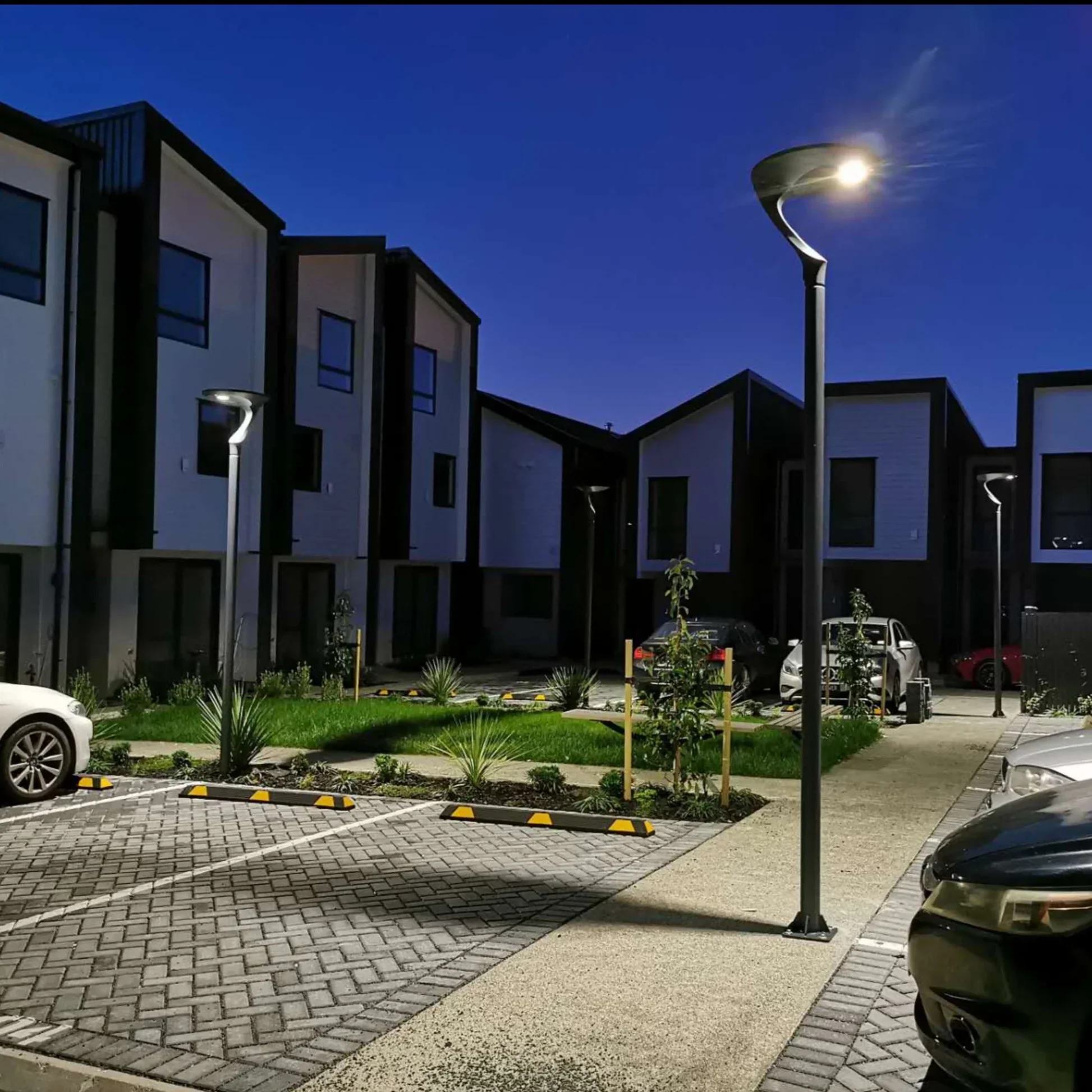
Car parks require consistent illumination to improve visibility for both drivers and pedestrians.
Commercial solar car park lighting is designed to provide broad coverage across open parking areas while minimising dark spots.
These systems are commonly installed at:
Shopping centres
Schools
Hospitals
Commercial office developments
Sporting facilities
Community centres
Higher mounting heights and wider light distribution help maximise coverage while reducing the number of poles required.
Solar Area Lights
Solar area lights are designed to illuminate larger open spaces rather than roads or pathways.
Typical applications include:
Industrial compounds
Public gathering areas
Recreation reserves
Warehousing facilities
Transport hubs
Business parks
Depending on the project, area lights may provide either symmetrical or asymmetrical light distribution to suit the site's layout.
Choosing the Right Fixture
Selecting the appropriate fixture depends on several factors, including:
The intended use of the space
Required lighting levels
Pole height
Site dimensions
Expected operating hours
Safety requirements
Compliance obligations
For many projects, a combination of fixture types provides the best outcome. For example, a council park may incorporate solar street lights for access roads, pathway lights for pedestrian walkways and flood lights for sports facilities or maintenance areas.

Understand Lumens Instead of Wattage
One of the most common misconceptions is that higher wattage automatically means brighter lighting.
For modern LED systems, lumens are a far more useful measure because they indicate the actual amount of visible light produced.
When comparing commercial solar lights, buyers should focus on:
Light output (lumens)
Light distribution
Uniformity
Efficiency
A well-designed optical system often delivers better lighting performance than simply choosing the fixture with the highest wattage.
Select the Appropriate Pole Height
Pole height has a significant influence on lighting performance.
A pole that is too low may create bright spots directly beneath the fixture while leaving surrounding areas poorly illuminated. A pole that is too high can reduce light intensity where it is needed most.
Typical pole heights vary depending on the application:
Pathways: lower poles for focused pedestrian lighting
Car parks: medium-height poles for wider coverage
Streets and roads: taller poles for greater spacing and uniform illumination
Lighting design calculations help determine the most suitable pole height for each project.
Battery Capacity Matters
The battery stores energy collected during the day and powers the light overnight.
An undersized battery may result in reduced operating hours during periods of poor weather, while an appropriately sized battery provides greater reliability and longer autonomy.
Commercial systems commonly use LiFePO₄ batteries because they offer:
Long service life
Excellent thermal stability
High charging efficiency
Reliable performance across a wide range of temperatures
Solar Panel Sizing
The solar panel must generate enough energy to recharge the battery based on the site's expected operating requirements.
Factors affecting panel sizing include:
Geographic location
Available sunlight
Seasonal variation
Daily operating hours
Battery capacity
Light output
Oversimplifying panel selection can lead to inconsistent performance, particularly during winter or prolonged cloudy conditions.
Operating Autonomy
Autonomy refers to the number of days a solar lighting system can continue operating without receiving sufficient sunlight.
Commercial buyers should consider expected weather conditions in the project location and specify a system with adequate battery reserves.
Projects requiring uninterrupted operation often prioritise greater autonomy to maintain lighting during consecutive overcast days.
Motion Sensors and Smart Controls
Many commercial solar lights include programmable controls that optimise energy usage.
Features may include:
Motion-activated brightness
Scheduled dimming
Timed operation
Adaptive lighting profiles
These intelligent controls help maximise battery efficiency while maintaining appropriate lighting levels when people or vehicles are present.
Colour Temperature
Colour temperature affects both visibility and the appearance of outdoor spaces.
Common options include:
| Colour Temperature | Typical Appearance | Common Applications |
|---|---|---|
| 3000K | Warm white | Parks, landscaped areas |
| 4000K | Neutral white | Pathways, schools, public spaces |
| 5000K–5700K | Cool white | Roads, industrial facilities, security lighting |
The appropriate choice depends on project objectives, user comfort and local lighting requirements.
Wind Rating and Structural Design
Outdoor lighting must withstand local environmental conditions, including strong winds.
Commercial buyers should ensure poles and mounting systems are designed for the relevant Australian wind region and comply with engineering requirements for the installation location.
This is particularly important in coastal regions and cyclone-prone areas.
Warranty and After-Sales Support
A commercial lighting system is a long-term infrastructure investment.
Before purchasing, buyers should consider:
Warranty coverage
Availability of replacement parts
Technical support
Product documentation
Supplier experience
Local support network
Choosing a reputable supplier with proven commercial experience can help reduce long-term ownership risks.
Commercial Buyer Checklist
Before selecting a commercial solar lighting system, confirm the following:
Lighting objectives have been clearly defined.
The correct fixture type has been selected.
Light output is based on lumens, not wattage.
Pole height suits the application.
Battery capacity provides sufficient autonomy.
Solar panels are correctly sized for the location.
Smart controls and motion sensors meet operational needs.
Colour temperature is appropriate for the environment.
Wind ratings and structural requirements have been verified.
Warranty terms and supplier support have been reviewed.
Australian Standards & Compliance
Commercial solar lighting should do more than provide adequate illumination—it should also be suitable for Australia's diverse environmental conditions and comply with relevant standards and project specifications.
Understanding a few key compliance requirements can help buyers compare products more confidently and reduce the risk of selecting systems that may not be appropriate for long-term commercial use.
-
Ingress Protection (IP) ratings indicate how well a lighting fixture is protected against dust and water.
The rating consists of two numbers:
The first relates to protection against solid objects and dust.
The second relates to protection against moisture and water.
Higher IP ratings generally indicate greater protection for outdoor environments, particularly where fixtures may be exposed to heavy rain, dust or coastal conditions.
-
IK ratings measure a fixture's resistance to mechanical impact.
This is particularly important in:
Public parks
Schools
Transport facilities
Sporting venues
High-traffic public spaces
A higher IK rating can provide greater protection against accidental impacts or vandalism.
-
Australia experiences a wide range of weather conditions, from coastal storms to cyclonic regions.
Lighting poles and mounting systems should be engineered to withstand wind loads appropriate to the installation site.
Factors influencing wind performance include:
Pole height
Fixture size
Solar panel dimensions
Local wind region
Foundation design
Selecting products with appropriate structural engineering documentation helps ensure long-term reliability.
-
Commercial lighting projects may need to consider Australian lighting standards depending on the application.
These standards help guide appropriate lighting levels, uniformity and safety outcomes for environments such as:
Roads
Car parks
Pedestrian pathways
Public spaces
Industrial facilities
Professional lighting design can assist in achieving suitable performance for the intended application.
-
Many council and commercial projects include additional procurement requirements beyond basic product specifications.
These may include:
Engineering certifications
Product testing documentation
Warranty requirements
Maintenance expectations
Compliance with project specifications
Asset management considerations
Reviewing these requirements early in the project can help avoid delays during procurement and installation.
Commercial Solar Lighting vs Traditional Lighting
Both commercial solar lighting and conventional mains-powered lighting have advantages depending on the project. The most suitable solution depends on site conditions, available infrastructure, project budget and long-term operating requirements.
| Feature | Commercial Solar Lighting | Traditional Mains Lighting |
|---|---|---|
| Installation | No grid connection required; minimal trenching | Requires underground cabling and electrical infrastructure |
| Maintenance | Periodic inspections and component replacement over time | Electrical infrastructure and lamp maintenance required |
| Electricity Costs | No ongoing electricity bills | Ongoing energy consumption |
| Operating Costs | Generally lower over the system lifecycle | Higher due to electricity and infrastructure maintenance |
| Lifespan | Long-life LED components and LiFePO₄ batteries | Varies depending on fixture and maintenance |
| Sustainability | Powered by renewable solar energy | Dependent on grid electricity |
| Reliability | Independent of the electrical grid when properly designed | Dependent on mains power availability |
When Commercial Solar Lighting Is the Better Choice
| Situation | Why It May Be Suitable |
|---|---|
| Power is unavailable or expensive to extend | Solar lighting can operate independently of the mains grid, avoiding the cost and complexity of extending electrical infrastructure. |
| Trenching would significantly increase project costs | Solar systems require minimal trenching compared with conventional lighting installations that need underground cabling. |
| Environmental impact needs to be minimised | Solar lighting uses renewable energy and can reduce reliance on grid electricity and associated infrastructure. |
| Remote or temporary installations are required | Off-grid operation makes solar lighting suitable for locations where connecting to mains power is impractical or unnecessary. |
| Sustainability objectives are a priority | Solar lighting can support sustainability goals by using renewable energy for ongoing operation. |
When Traditional Lighting May Be More Suitable
| Situation | Why It May Be Suitable |
|---|---|
| Existing electrical infrastructure is already available | Connecting to existing infrastructure may be more practical where suitable mains power is already in place. |
| Very high continuous lighting levels are required | Mains-powered systems may be better suited to applications requiring consistently high illumination levels. |
| Site conditions limit solar access | Heavy shading or other site conditions may limit the effectiveness of solar panels. |
| Integration with existing electrical systems is required | Conventional lighting may be more appropriate where project specifications require integration with established electrical systems. |
The best solution depends on the specific needs of the project rather than a one-size-fits-all approach.
Common Mistakes When Buying Commercial Solar Lighting
Choosing the wrong commercial solar lighting system can result in poor performance, increased maintenance and higher long-term costs. Many issues arise not because solar lighting is unsuitable, but because key project requirements were overlooked during the purchasing process.
Choosing by Wattage Alone
A common mistake is comparing products solely by wattage.
Wattage indicates energy consumption, not lighting performance. Buyers should instead evaluate lumens, light distribution, optical design and overall system efficiency.
Selecting the Wrong Pole Height
An incorrectly sized pole can compromise lighting performance, creating uneven illumination or excessive glare.
Pole height should always be matched to the application and supported by an appropriate lighting design.
Underestimating Battery Autonomy
Weather conditions vary across Australia, and systems with insufficient battery capacity may struggle during extended periods of cloud cover.
Selecting adequate battery autonomy helps maintain reliable lighting throughout the year.
Ignoring Compliance Requirements
Not all commercial lighting products provide the same level of documentation or engineering support.
Before purchasing, confirm that the system meets relevant project requirements for:
Structural performance
Environmental protection
Product quality
Applicable standards
Buying Solely on Price
The lowest purchase price does not always represent the best long-term value.
Lower-cost products may compromise component quality, battery performance, durability or support, potentially increasing maintenance and replacement costs over time.
Evaluating the total cost of ownership provides a more meaningful comparison than focusing solely on upfront pricing.
Overlooking Warranty and Technical Support
Commercial lighting systems are expected to perform for many years.
Before making a purchasing decision, buyers should assess:
Warranty coverage
Availability of technical assistance
Replacement components
Supplier experience
Product documentation
Reliable after-sales support can be just as important as the product itself when managing long-term infrastructure assets.
Frequently Asked Questions
How long do commercial solar lights last?
Commercial solar lighting systems are designed for long-term outdoor use. High-quality LED luminaires can often provide tens of thousands of operating hours, while LiFePO₄ batteries typically offer a long service life when correctly specified and maintained. The overall lifespan depends on component quality, environmental conditions and routine maintenance.
Do commercial solar lights work during winter?
Yes. Commercial solar lights continue to operate during winter by charging whenever daylight is available. Because winter days are shorter and sunlight intensity is lower, professionally designed systems use appropriately sized solar panels and battery storage to maintain reliable performance throughout the season.
How many cloudy days can commercial solar lights handle?
This depends on the system's battery autonomy. Commercial-grade solar lighting is commonly designed to continue operating through multiple consecutive cloudy days. The required autonomy should be selected based on the project's location, lighting requirements and expected weather conditions.
Are commercial solar lights waterproof?
Commercial solar lights are designed for outdoor environments and typically feature weather-resistant enclosures with suitable IP ratings. These ratings indicate the level of protection against dust and water ingress, making them suitable for long-term outdoor installation when used as intended.
Can commercial solar lighting replace mains-powered lighting?
In many applications, yes. Modern commercial solar lighting can effectively illuminate streets, pathways, parks, car parks and public spaces without connecting to the electrical grid. The suitability of solar lighting depends on factors such as lighting requirements, available sunlight, operating hours and site conditions.
What maintenance is required?
Commercial solar lighting generally requires minimal maintenance. Routine tasks may include inspecting the fixture and mounting hardware, cleaning the solar panel if dirt or debris reduces performance, checking battery health where applicable and ensuring vegetation does not shade the panel over time.
Is commercial solar lighting suitable for councils and public infrastructure?
Yes. Commercial solar lighting is widely used by local councils for roads, pathways, parks, recreational facilities and public open spaces. It offers a practical solution where extending mains power would be costly or disruptive, while also supporting sustainability initiatives.
Do I need planning approval to install commercial solar lighting?
Approval requirements vary depending on the project location, land ownership and local council regulations. While some installations may not require formal approval, larger developments or public infrastructure projects may need planning, engineering or electrical approvals. It's advisable to confirm local requirements during the planning stage.
Can commercial solar lights be installed in remote locations?
Yes. One of the primary advantages of commercial solar lighting is that it operates independently of the electrical grid, making it well suited to remote roads, parks, agricultural properties, mining operations and construction sites where mains power is unavailable or impractical.
How do I choose the right commercial solar lighting system?
The best system depends on your project's lighting objectives, site layout, operating hours, required light levels and environmental conditions. A professional lighting assessment can help determine the appropriate fixture type, pole height, battery capacity and solar panel sizing to ensure reliable long-term performance.
Conclusion
Commercial solar lighting has evolved into a dependable solution for illuminating outdoor spaces across Australia, offering a practical alternative to traditional mains-powered lighting for many commercial, public and industrial projects.
Whether you're planning lighting for a council streetscape, school campus, commercial car park, public park or construction site, selecting the right system requires careful consideration of more than just product specifications. Factors such as lighting objectives, lumens, battery autonomy, solar panel sizing, pole height, environmental conditions and compliance all contribute to long-term performance and value.
By understanding these key considerations, commercial buyers can make more informed decisions, reduce installation and operating costs, and invest in lighting systems that deliver reliable performance for years to come.
Every project has unique requirements, and the right solution will depend on your site's layout, operating profile and performance expectations. If you're planning a commercial solar lighting project, consider requesting a professional lighting design and quotation to ensure the selected system is appropriately matched to your application.
